Beginner’s Guide to Hiking 14ers in Colorado (Class Ratings and First 14er Tips)
In this beginner’s guide to hiking 14ers, I’ll break down class ratings, altitude considerations, safety tips, common mistakes, and the easiest 14ers to start with.
Hiking 14ers is almost a rite of passage for Colorado outdoors people. With 58 peaks above 14,000 feet, Colorado has more 14ers than any other state. They range from straightforward treks to highly technical climbs.
➡️ Did you know that the iconic Maroon Bells are 14ers? These are extreme climbs. I’d recommend sticking to the Crater Lake Trail for an easy day hike, where you can still admire the Bells.
If you’re new to high-altitude hiking, choosing your first 14er can feel overwhelming. How hard are 14ers really? Are they dangerous? What class rating should you start with? And what’s the easiest 14er for beginners?
I’ve hiked over a dozen Colorado 14ers, including Mount Elbert, Pikes Peak, Mount Sneffels, Mount Yale, Mount Princeton, and more. I’ve learned that not all summits are created equal. After reading my guide, you can choose a peak that matches your experience level and hike it safely.
➡️ Looking for more Colorado adventures? Check out my Colorado outdoor adventure hub for more inspiration.
Disclosure: This post may contain affiliate links. If you purchase through these links, I may earn a small commission at no extra cost to you. I only recommend products I’ve personally used, tested, and genuinely love. Thank you for supporting Emma Gets Outside!
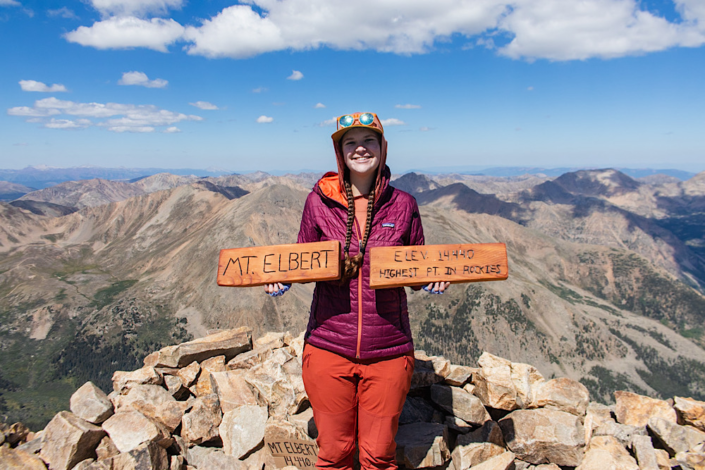
Hiking 14ers in Colorado at a Glance
- Total Colorado 14ers: 58
- Easiest class rating: Class 1
- Best season for beginners: July–September
- Average distance: 6–14 miles
- Average elevation gain: 2,000–5,000 feet
➡️ Discover the easiest 14ers in Colorado with my detailed guide. Includes your first 14er recommendation, trail stats, comparisons, and more.
What are 14ers?
A 14er is a mountain that is at least 14,000 feet tall at its peak. There are 96 14ers in the United States, with Colorado containing 58 of them. The 14ers in Colorado are among the best-known, with people aiming to complete all 58 over their lifetimes.
Why is hiking 14ers a big deal?
I had never heard of a 14er before moving to Colorado. Peak bagging (summiting a list of mountains, such as all the 14ers in Colorado) is a source of pride for outdoor enthusiasts. It comes with some bragging rights and offers incredible adventures.
For me, I always say there’s nothing quite like the view from the top of a 14er. It’s immensely gratifying to reach the summit. Some peaks are a lot more physically challenging than others.
How hard is hiking 14ers?
Well, the difficulty of the 14er depends on several factors. Some are steep hikes, while others are considered technical rock climbs.
Factors that Affect 14er Hike Difficulty
- Trail condition
- Exposure
- Loose rock (talus and scree)
- Distance
- Elevation gain
- Class rating

Example of Talus Slope on Torreys Peak
Key Terms For Hiking 14ers That Everyone Should Know
Before choosing your first 14er, it helps to understand some common mountain terminology.
Technical Terrain
When a trail has a “technical section,” that means the difficulty shifts from basic hiking or walking to moves that require careful footwork or handholds. Technical terrain can encompass a wide variety of obstacles, so describing it using the following terms is more helpful.
Ridge
An elevated spine with a drop-off on both sides. A knife-edge is an extreme example in which climbers straddle the edge, with drop-offs of potentially thousands of feet. A ridge can be relatively wide with minimal exposure.
Exposure
If you’re hiking along a narrow and steep ridge, your exposure can be high, and the drop-offs are a long way down. High exposure means a fatal fall with any misstep.
Talus Slope
Talus refers to small rocks or large boulders set on a slope. They can be relatively stable depending on their size and placement. You may hear the term “boulder hopping,” which just means stepping from rock to rock up or down the mountain.
Scree Field
Scree are tiny rocks, think pebble size, that are loose on a slope. When you take a step, the scree moves with you. Misplaced footing can cause you to slide.
Scramble
Scrambling is between hiking and rock climbing. You need your hands and feet to traverse boulders or climb up a steep section of rock. It’s not so technical that you need any gear like ropes.
Traverse
If you’re traversing a slope, you’re moving diagonally down and across rather than straight down. This can be a safer way to descend than down a steep face. A traverse may also refer to a ridge connecting two peaks.
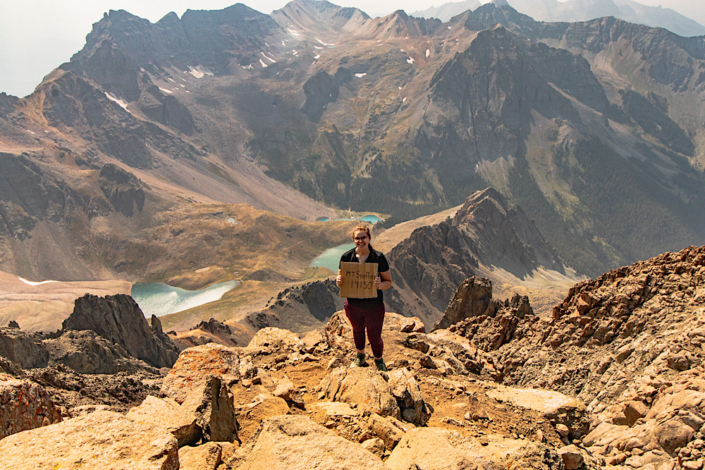
Mount Sneffels Summit View
14er Class Ratings
When selecting a 14er to hike, the most important distinction is class rating.
Class 1 14ers
Basic hiking on an established trail. It might be steep, but there’s no need to use your hands for this type of mountain.
Class 2 14ers
Rugged hiking or minimal scrambling that may require the use of your hands. Think boulder hopping and loose scree or talus.
Class 3 14ers
Scambling that requires three points of contact for safety (two feet, one hand, or vice versa). You may want a rope for certain class 3 moves with high exposure.
Class 4 14ers
Now this is actual climbing. Generally, there is an established route with hand and footholds. A rope is often used for vertical terrain with lots of exposure.
Class 5 14ers
Technical climbing. You need a rope, a harness, and protective equipment.
Distance and Elevation Gain Difficulty
Beyond class ranking, distance and elevation gain are the other two factors that determine how hard a 14er is.
Over 10 miles, 2,000 feet of gain might not feel like very much. But over 1 mile, 2,000 feet of gain is steep.
The rule is that a slope of about 1,000 feet or more per mile is considered steep. In contrast, 500 to 1,000 feet is moderately steep. Add 30 minutes to an hour onto your flat hiking pace to determine how long it will take to hike with elevation gain.
Is hiking 14ers dangerous?
14ers certainly can be dangerous. On average, 5-10 people die each year while attempting to summit a 14er. The most common cause of death is falling (think narrow ridge, high exposure).
How to Reduce Risk
- Choose an appropriate class rating
- Don’t overestimate your ability
- Check the weather ahead of time
- Monitor weather conditions on the trail
- Turn around when needed
- Pack layers
- Bring enough water
People may overestimate their abilities and attempt an expert’s only route. I’d say, if you’re an average fit hiker and you’re smart about your safety, climbing a class 1 or 2 mountain can pose minimal risk.
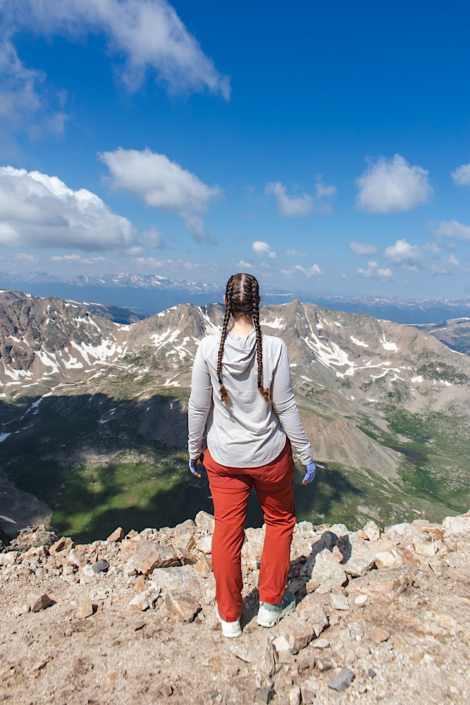
Mount Democrat Summit
Hiking 14ers High Elevation Considerations
Hiking above 8,000 feet can cause altitude sickness, especially if you are ascending quickly, such as when hiking 14ers. If you’re coming from sea level or close to it, you’re more likely to experience altitude sickness on 14ers because your body hasn’t had time to adjust.
➡️ Want to drive instead of hike at high elevations? Try driving Ophir Pass in Colorado for insane views.
Altitude Sickness Symptoms
Know the signs of altitude sickness so you know when to safely start descending.
- Dizziness
- Nausea
- Headache
- Fatigue
Severe Signs to Watch For
- Severe shortness of breath at rest
- Chest tightness
- Rapid heart rate
Dehydration While Hiking 14ers
Note that fatigue, dizziness, and headaches can also be signs of dehydration. In severe cases of dehydration, you can also experience a rapid heart rate. Drink lots of water when you’re hiking 14ers to rule out dehydration as a cause for concerning symptoms.
What to Do if You Feel Sick
Make sure you’re drinking plenty of water and have had a snack. Complex carbs and foods high in potassium are great for combating altitude sickness. Pack foods like trail mix (nuts and dried fruit), granola bars, bananas, and chocolate for your 14er hike.
While sugary foods like candy can provide fast energy, you’re better off with snacks that provide a gradual energy release. Your body requires less oxygen to metabolize carbohydrates than sugar.
Electrolytes also help keep your body hydrated. If you drink too much water or are sweating a lot, you’re flushing the salt from your system. Electrolytes increase sodium and other mineral levels to aid muscle and nerve function.
If you’re still not feeling good after a drink, snack, electrolytes, and rest, it’s a good idea to turn around. You don’t want to make a summit push only to feel too sick to descend. That’s when search and rescue gets called.
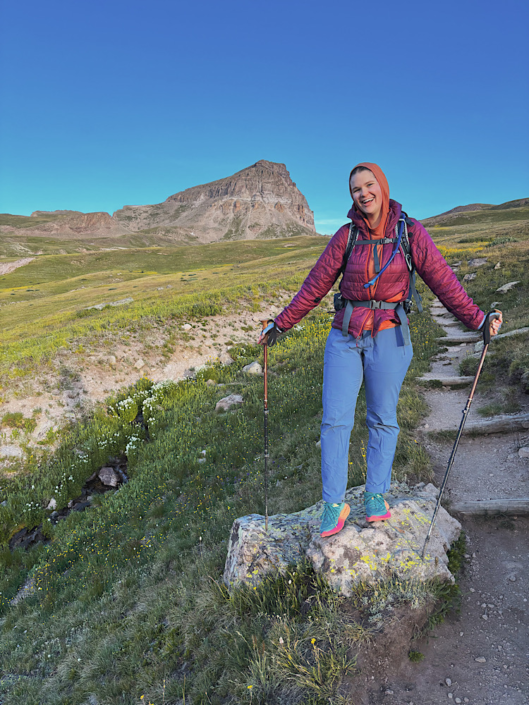
Alpine Start Hiking Uncompahgre Peak
When Is the Best Time to Hike 14ers?
The best time for beginners to hike 14ers is when there is minimal snow at high elevations. That time usually falls between July and September. Watch the weather carefully and read AllTrails reviews for current conditions.
There was a time when my friends and I drove to Lake City in early September to hike a 14er, and we hadn’t checked AllTrails until the night before we planned to summit. The reviews mentioned snow and slippery conditions at high altitude. We didn’t have any micro-spikes, so we decided not to attempt the hike.
The best thing you can do is not hike in conditions that are outside of your skill set. August is the best month of the 14er season in Colorado because by then, most of the snow has melted and new snow has yet to fall.
14er Hiking Safety Tips for Beginners
Hiking in exposed, high-alpine conditions can pose risks if you don’t watch the weather and play it safe.
Research Your Route Before Hiking 14ers
Use 14ers.com as a resource for planning your route. They have photos and detailed trail descriptions that help you know what to expect. You can find updated trip reports from real hikers with current trail conditions.
I also have a book called Colorado’s Fourteeners: From Hikes to Climbs that I absolutely love. Flipping through the book makes it easy to quickly compare mountains and bookmark future hikes.
I make sure to download the route I’m following on AllTrails, and send it to my Garmin watch before starting the hike. Having two copies of the map that I can access without cell service gives me peace of mind.
Alpine Start for Hiking 14ers
On the day of your 14er hike, an alpine start (hiking between midnight and 4 am) might be necessary to reach the top before noon safely.
You should be off the summit or below tree line by noon. I’ve often seen storms crop up seemingly out of nowhere around 1 to 3 pm. The sky starts to darken quickly.
Lightning on 14ers
If you’re in an exposed area (no trees) and you’re the tallest thing, your chances of getting struck by lightning rise dramatically. 14er lightning danger is real and should be taken seriously.
If you do find yourself out in the open during a storm and don’t have a quick and safe way to descend into the trees, you’ll need to take the lightning position. Balance on the balls of your feet and crouch down. Cover your head and ears.
You want as little contact with the ground as possible and should be 50 to 100 feet away from another person. Crouch atop your backpack to further reduce ground contact and its current. Avoid water like lakes and streams, as well as metal objects like hiking poles.
Set a Turnaround Time
If you haven’t yet reached the peak and it’s starting to get later in the day, you should turn around and avoid the chance of being stuck in a storm. At the end of the day, having the chance to summit another mountain is better than summiting your last.
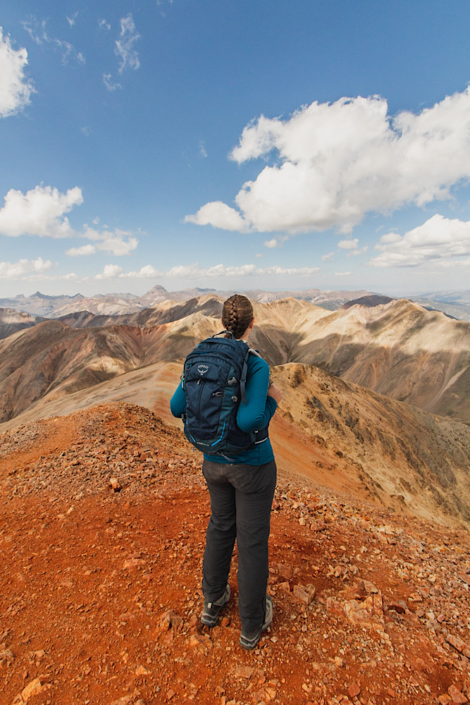
Redcloud Peak Summit View
What to Pack for Hiking 14ers
My 14er packing list includes everything on my day hike packing list. Check out that post for more details on what to bring on a 14er.
You’ll also need enough backpack capacity for water, food, extra layers, and emergency gear. My guide to the best hiking daypacks explains the different sizes I use and why my 24L pack is my go-to for most mountain hikes.
14er Gear List
- Trekking poles
- Warm layers
- Hat and mittens (optional)
- Rain jacket
- 3L water minimum (sometimes I bring 5-7 L)
- Electrolytes
- Snacks
- Headlamp
- Map/GPS/Downloaded trail info
- Sun protection
- Sun gloves
- Long sleeve shirt
- Sunglasses
- SPF lip balm
Wear a decent pair of footwear. This is critical on steep terrain. Check out my comparison guide on trail runners vs hiking boots to determine which are best for you.
Common Mistakes While Hiking 14ers For the First Time
I see people in the mountains all the time making beginner 14er mistakes. When I was hiking Mount Elbert, I literally caught a man from collapsing to the ground. He was severely dehydrated, and I gave him some of my electrolytes.
- Starting too late
- Not bringing rain and warm layers
- Underestimating elevation
- Not checking the weather
- Not bringing enough water
- Not eating enough
- Chasing the summit and not turning around
Easiest 14ers for Beginners
If you’re looking for your first 14er to hike, try some of the easiest 14ers in Colorado. I’ve hiked a few of the best 14ers for beginners, and would recommend them if you’re in decent physical shape with hiking experience.
Beginner 14ers I’ve hiked and would recommend:
- Mount Sherman
- Mount Democrat
- Mount Bierstadt
- Grays Peak
- Torreys Peak
- Handies Peak
- Uncompahgre Peak
Out of all of these, I thought Mount Sherman was the least technical and easiest climb — a great first 14er for most people.
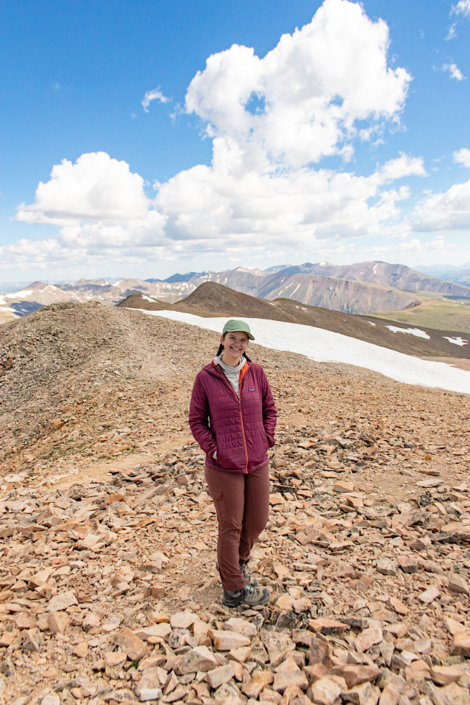
Easiest 14er in Colorado: Mount Sherman Summit
Frequently Asked Questions About Hiking 14ers
How many 14ers are in Colorado?
There are 58 officially recognized 14ers in Colorado, making it the state with the most 14,000-foot peaks in the United States. If you only count peaks that are within 300 feet of prominence, there are 53.
What is the easiest 14er in Colorado?
Several Colorado 14ers are considered beginner-friendly, including Mount Sherman, Mount Bierstadt, Grays Peak, and Handies Peak. These mountains are typically Class 1 or 2 hikes with well-established routes and moderate elevation gain compared to more technical 14ers.
How hard is it to hike a 14er?
The difficulty of hiking a 14er depends on the mountain’s class rating, elevation gain, terrain, and exposure. Some 14ers are straightforward hikes on established trails, while others require scrambling or technical climbing skills.
Are 14ers dangerous?
14ers can be dangerous, particularly due to high exposure, falling hazards, sudden weather changes, and altitude sickness. Most accidents occur from falls or lightning. Choosing an appropriate route and starting early significantly reduces risk.
What month is best for hiking 14ers in Colorado?
For beginners, July through September is generally the safest time to hike 14ers. By mid-summer, most snow has melted from standard routes, and winter conditions have not yet returned.
Do you need special gear to hike a 14er?
Most beginner-friendly 14ers (Class 1 or 2) do not require technical climbing gear. However, hikers should bring proper layers, sun protection, 3+ liters of water, navigation tools, and a headlamp in case of delays.
Final Thoughts on Hiking 14ers in Colorado
Hiking a 14er is one of the most rewarding challenges you can take on in Colorado. Whether you’re aiming for your first summit or slowly working your way through the list, preparation is everything. Understanding class ratings, elevation gain, weather patterns, and altitude risks will help you choose a mountain that fits your experience level and keeps you safe.
➡️ If you’re looking for more outdoor challenges in Colorado, backpacking the Four Pass Loop is an excellent place to start.
You don’t need to be an elite athlete to hike a 14er, but you do need to respect the mountain and be willing to turn around if conditions aren’t right. With the right planning, gear, and mindset, standing on top of a 14,000-foot peak is an experience you’ll never forget.
Start smart, hike early, pack well, and enjoy the journey to the summit.
📌 Pin this image on Pinterest to save this post for reference.