Canyonlands Maze District: What It’s Like in Total Isolation
The Canyonlands Maze District is the most remote and rugged section of Canyonlands National Park, known for its challenging roads and complete isolation.
In the Maze District, you’ll encounter difficult off-road obstacles, cliff-side campsites, and remote hiking trailheads. The only lights you see at night are from a potential lone car driving in or out from viewpoints. The only sound you hear is the wind in your ears. Sunrise and sunset paint the sky with cotton-candy colors and bathe the sandstone in a honeyed glow.
Hardly any evidence of humans exists, besides the worn roads and cairn stacks. This is the place you go to get away from it all. To experience the desert in its raw form. The Canyonlands Maze swallows you up as you descend deeper, all the way to the canyon floor.
➡️ If you’re looking for a day-by-day itinerary see: The Maze in Canyonlands 4-Day Itinerary
➡️ Need help with permits and planning? The Maze Utah: Permits and Gear
Disclosure: This post may contain affiliate links. If you purchase through these links, I may earn a small commission at no extra cost to you. I only recommend products I’ve personally used, tested, and genuinely love. Thank you for supporting Emma Gets Outside!
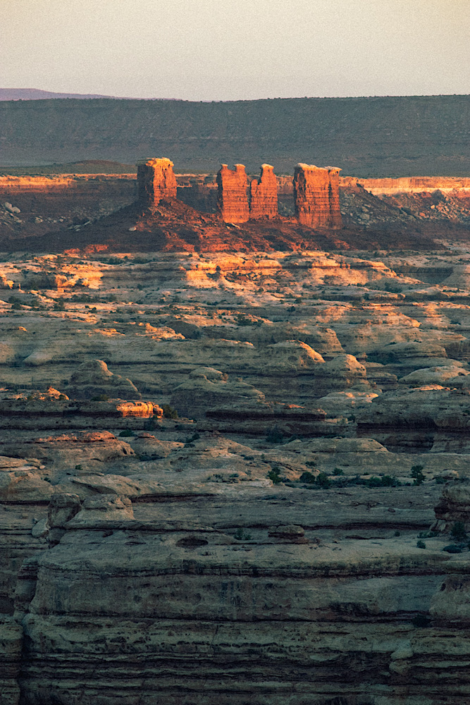
What the Canyonlands Maze District Actually Feels Like
As my comrades and I drove farther into the Canyonlands Maze District, the remoteness really started to sink in. I knew we were going to a lesser-visited section of Canyonlands National Park, but I didn’t expect how few people we actually saw.
A few groups and some were out by themselves. No doubt all came here to revel in the solitude and empty hiking trails. Visiting the Canyonlands Maze isn’t just remote; it’s one of the most difficult areas of the park to access.
The roads were rougher than I imagined. Taking hours to advance a handful of miles. I could have hiked faster than we were driving some of the more technical sections.
When we finally reached camp for the night, we would all go quiet as the sun set. Reflecting on the day’s sightings. Pointing out in the landscape, “we were all the way over there this morning.” And “that’s where we are going tomorrow.”
How Remote the Maze Really Is
When you look at a map, the Maze doesn’t seem that remote. Yes, it’s about 100 miles from the town of Hanksville to the Doll House (the farthest part of the Maze), but driving at highway speeds, you’d be there in a couple of hours or less.
That’s the thing, though, you’re driving at a near crawl the deeper you explore. Plus, there aren’t any pit toilets or water spigots. You are completely self-reliant. Driving through the Maze can’t be accomplished with a casual day trip. You need a certain level of commitment and preparedness.
➡️ Check out nearby Colonnade Arch if you want another remote adventure with a high natural reward.
Planning a bigger Southern Utah trip? I’ve pinned over 100 hikes, viewpoints, campgrounds, and hidden gems in my interactive Southern Utah Rexby guide.
Hiking in the Maze
➡️ Discover more Utah hiking destinations with my informative guides.
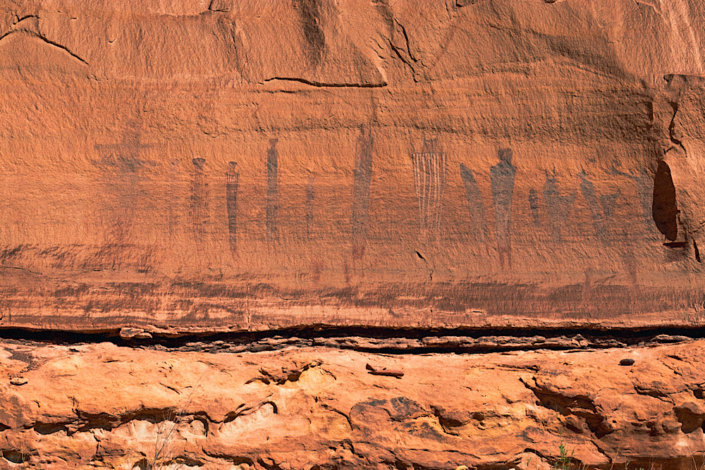
We didn’t see a soul during our 10-mile hike in the Canyonlands Maze to the Harvest Scene. It’s not often I don’t cross paths with another person on a trail of this distance, let alone in a National Park on a well-known hike.
➡️ Hike nearby Horseshoe Canyon if you’re interested in incredibly preserved pictographs. It’s also in the Maze District, but much more accessible than the Harvest Scene.
The Land of Standing Rocks is a level above the Maze floor, featuring campsites and the beginnings of trails. We started hiking along a ridge with canyons sloping off on either side. With little shade, the park ranger recommended we begin the loop here rather than end with a couple of miles of slogging in the sun.
As I was looking down into the canyon, I kept wondering how and where we would make our descent. The walls grew nearly straight up from below. Further, we hiked along the ridge until an abrupt turn nudged us towards our entry point.
Walking atop smooth sandstone always makes me think of the moon’s surface. The desert in itself often feels like a different planet. Balancing rock formations, unexpected colors, and surprising evidence of life (although not human life) make the desert a landscape of curiosity. There’s something to discover around every corner.
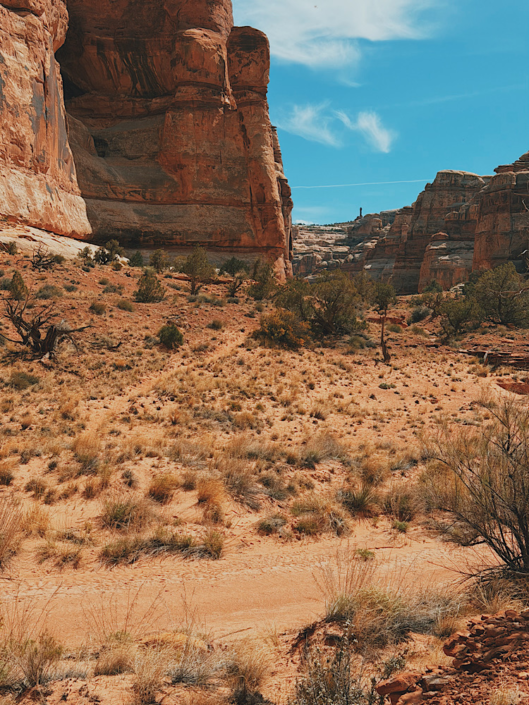
Chimney Rock sticking up in the background
The Canyon Floor
This place is called the Maze for a reason. Once we set foot on the sandy canyon ground and made our way to the main channel, the various offshoots beckoned exploration. One looks to be as legitimate as the next. Veins that continue for miles to dead ends. No way to know which one leads to the way out. The walls tower high, so features on the rim can no longer be used to navigate.
If not for my downloaded map, I surely would have continued on the likely, albeit wrong path. The occasional cairn like a neon sign “THIS WAY.” Standing out in the otherwise untouched ecosystem. Navigation in the Canyonlands Maze can be tricky, especially once you’re on the canyon floor.
It was hot down in the canyon as the sun grew stronger and reflected off the walls, like being baked in an oven. The only reprieve is the shadow of another cliff face or a well-placed juniper tree parallel to the trail.
Finally, we approached the Harvest Scene. Pictographs are paintings or drawings on the rock surface, whereas petroglyphs are carved into the rock to create shapes. In this case, the Harvest Scene pictograph was painted with red and white mineral pigments, considered one of the best-preserved pictograph sites in North America.
Deep sand made for slower travel. Sucking in our feet with every step. Treading on the rock again felt so fast in comparison. We ascended much the way we came in, via a more gradual channel to the rim. Chimney Rock became visible as the walls opened up, a marker for our destination.
The Hardest Part of Visiting the Canyonlands Maze District
Driving on rough 4WD “roads,” if you can even call them that, was by far the most taxing part of visiting the Canyonlands Maze. Rocks had to be stacked just so for the truck tires to slide down them without a huge dip. Spotters had to direct the driver on tire placement and how far to turn to avoid precarious angles.
Getting stuck was a real reality. Tires spinning with no traction, the frame teetering on a fulcrum rock. Give it just enough gas, but too much can dig you deeper into a hole. There were times, I’m sure, when we all doubted whether this was worth the hassle of the drive.
Most Memorable Moments in the Canyonlands Maze
Some of my favorite moments in the Canyonlands Maze had nothing to do with hiking.
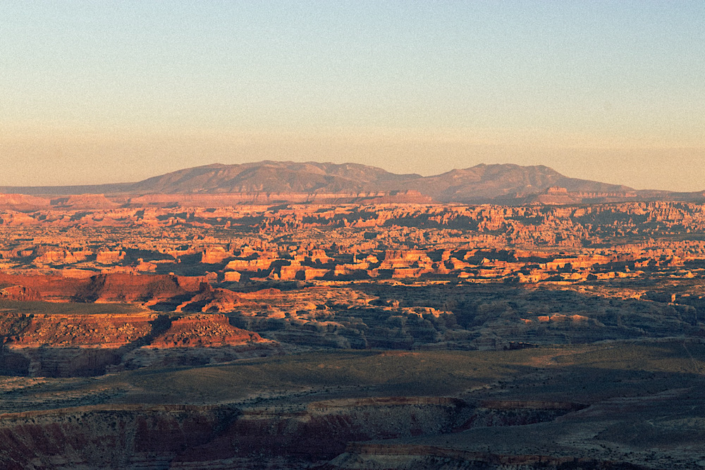
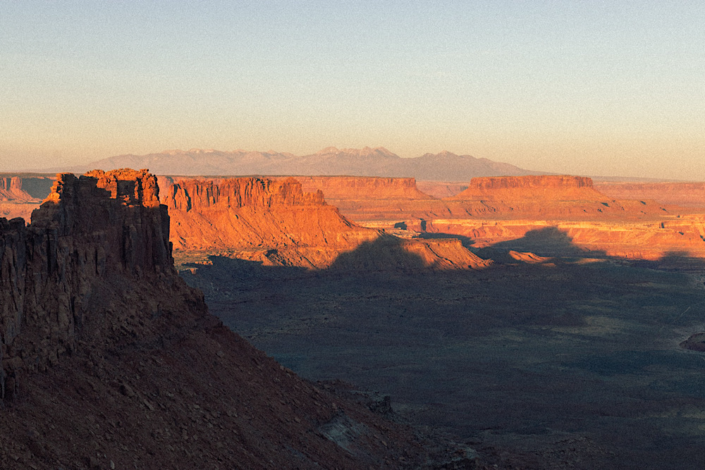
The first night at Panorama Point, we quickly set up camp and ate tacos as we waited for the sun to get low on the horizon. The Island in the Sky and Needles districts are both visible, with the La Sal and Abajo mountains behind them, respectively. Pink peaks, orange rocks, and dark blue canyons layered our view.
The sunrise at the same location elicited an entirely opposite feeling. Rising over the La Sals and setting the cliffs below camp ablaze. Such a privilege to experience the two best times of day in the same spot and compare how the light weaves itself among the layers.
What Surprised Me Most About the Maze District
I couldn’t believe we were in a National Park. Usually, I associate National Parks with crowds and the impact they leave (footprints, trash, noise, etc.). The Maze was more like exploring well-tended BLM land — very few people, and a sense of wildness about it.
Being that it was a nice weekend in March, I thought more people would be out and about. A pleasant surprise to find my group had the place to ourselves most of the time. It didn’t feel like a typical visit to a National Park; it felt like true backcountry travel.
What I’d Do Differently Next Time
If you’re planning a trip to the Canyonlands Maze, don’t underestimate how much time you’ll need. It would have been ideal to have a couple more days to hike. The effort getting there will be better rewarded with more time to enjoy it.
📌 Pin this image on Pinterest to save this post for reference.