Horseshoe Canyon Hike: Ancient Pictographs Deep in Canyonlands
See some of the best-preserved pictographs in all of North America in Horseshoe Canyon, Utah.
Horseshoe Canyon is well known for its pictograph panel, the Great Gallery. But did you know there’s more to the canyon? There are four ancient, storied rock panels, hidden details, and surprises most hikers walk right past. You may even find an artifact or two. This trail near Moab completely exceeded my expectations.
Read about what to expect and what to look for while you’re hiking Horseshoe Canyon.
➡️ Find more picturesque Utah hikes in my Utah Adventure Guide. Features trails in National Parks and more remote locations.
Disclosure: This post may contain affiliate links. If you purchase through these links, I may earn a small commission at no extra cost to you. I only recommend products I’ve personally used, tested, and genuinely love. Thank you for supporting Emma Gets Outside!
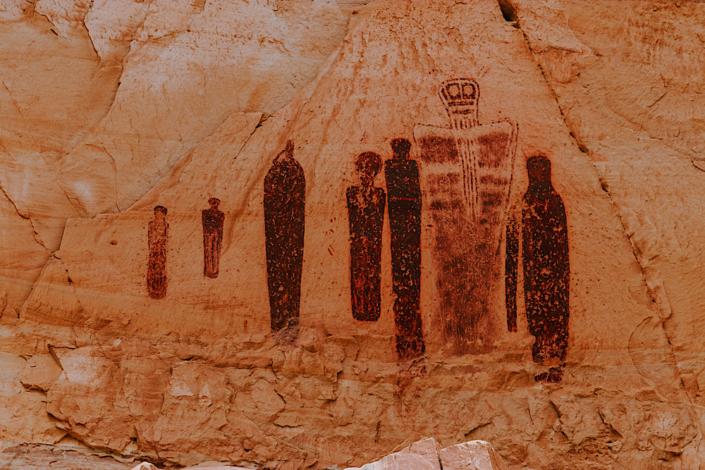
Holy Ghost Panel at the Great Gallery
Where is Horseshoe Canyon?
Horseshoe Canyon is a remote hiking area in Canyonlands National Park. The canyon is managed as part of the Maze District.
Most visitors see the Island in the Sky District (near Moab) and maybe the Needles District if they’re feeling adventurous. Horseshoe Canyon in the Maze District is over a 2.5-hour drive from the Island in the Sky visitor center.
➡️ See my 4-Day Canyonlands Maze itinerary to plan a trip to the Maze district. Horseshoe Canyon is not a part of the itinerary, but can be easily added before reaching the true Maze District.
The Canyonlands Maze District is extremely remote and thus sees far fewer visitors than the other districts. You might have heard of Horseshoe Canyon as part of the movie 127 Hours, based on the true story by Aron Ralston, Between a Rock and a Hard Place. Aron’s truck was parked at the Horseshoe Canyon trailhead.
➡️ You don’t need a permit to camp near Horseshoe Canyon, but you must have a permit to camp anywhere else in the Maze District. Learn more about Maze District camping permits.
Planning a bigger Southern Utah trip? I’ve pinned over 100 hikes, viewpoints, campgrounds, and hidden gems in my interactive Southern Utah Rexby guide.
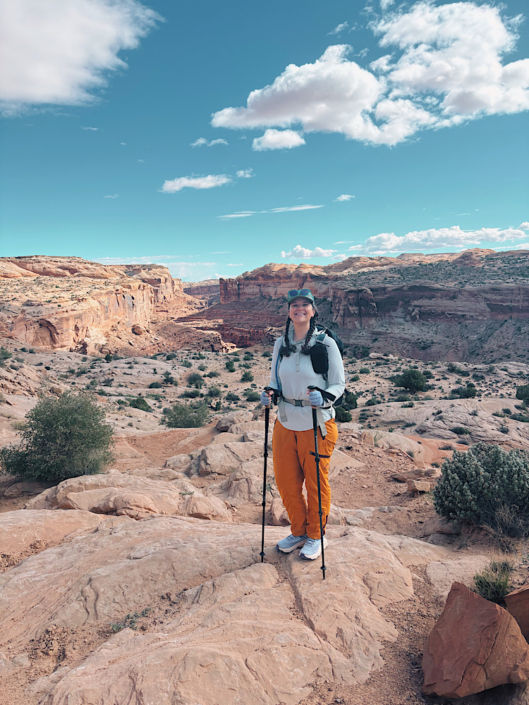
How to Get to Horseshoe Canyon
There are a couple of ways to get to Horseshoe Canyon. The fastest being from Hanksville, but you can also come in from Green River. I explain the road conditions from both directions in my post about hiking to Colonnade Arch and Crocodile Rock (a hike I highly recommend if you’re heading out to this area).
You’ll drive miles on dirt roads to get to the Horseshoe Canyon trailhead from either direction, so keep that in mind when planning your itinerary. The road is well-maintained, but you certainly won’t be driving at highway speeds.
Use this Google Map pin location to get to the trailhead: Horseshoe Canyon Trailhead Parking. Download Google Map sections before you head into the backcountry, as there is no cell service.
➡️ If you’re looking for more hiking to do in this region of Utah, check out the Goblin’s Lair in Goblin Valley State Park. It’s easily accessed from the highway and is considered a moderate trail. The Goblin’s Lair is a unique slot canyon formation that I had a ton of fun exploring.
Horseshoe Canyon Trail Overview
- Distance: 7.3 miles
- Elevation gain: 1,400 feet
- Difficulty: Moderate
- Trail type: Out-and-back
- Horseshoe Canyon Trail Map
You descend into the canyon from the parking area, so be prepared to hike back up in the afternoon sun. Have plenty of water and electrolytes for the uphill trek.
Once you’re down in the canyon, I didn’t feel much elevation gain, and we took breaks in the shade of the cottonwoods.
➡️ Hike Mary Jane Slot Canyon near Moab if you want another canyon hike without much elevation gain. It’s very refreshing in hotter months, as you walk through Professor Creek for most of the hike.
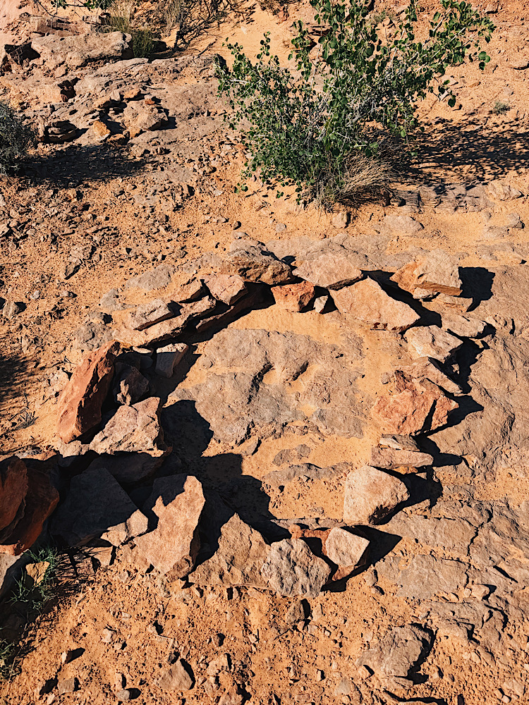
Can you see the dinosaur footprint?
What the Horseshoe Canyon Hike is Actually Like
The Descent from the Rim
There is a pit toilet at the trailhead, which was an unexpected amenity. A volunteer park ranger might be at the trailhead if you start your hike in the morning. We chatted with Ranger Jim before setting off.
Keep your eyes peeled for a dinosaur footprint on the left side of the trail as you descend. There was a ring of rocks around it, and it was right next to the trail. It is on the AllTrails map if you have trouble locating it.
You’ll notice a trough right before the descent gets steeper. Sheep grazed down in the canyon up until the mid-1900s. Farmers would herd the sheep up and down the trail now used for hiking to reach Barrier Creek. You’ll also notice a long pipe that extends all the way to the canyon floor for pumping water.
Take in the views from the canyon rim. I find that the desert has a way of making you feel small. The horizon seems to expand forever while tiny details in the landscape capture your attention.
The sandy hill is the steepest part of the hike. Super fun to run down, not so fun to hike up.
Walking the Canyon Floor
Right as we hit the canyon floor, we caught up to Ranger Jim. He asked us if we wanted to hike with him and hear stories about the canyon. We immediately said yes. Any chance you get to hike with an expert, take it. You’ll learn so much and appreciate your experience that much more.
Jim talked as we meandered the sandy wash, pointing out porcupine tracks and picking up worked pieces of flint for us to admire. He mentioned the canyon’s history with sheep grazing and mining.
Prospectors built a road opposite the present-day hiking trail to get drilling equipment into the canyon. You can still see the straight line of the road as you hike down. They never found any oil or other valuable minerals, but the landscape is still scarred from their efforts.
I’ll go into more detail about each of the storied rock panels below. We walked with Ranger Jim to the High Gallery and the Horseshoe Shelter, then we continued to the Great Gallery on our own.
The hiking was easy, just walking in the sand with no way to get lost. The miles passed slowly in the best possible way because we kept stopping to notice new details.
The Climb Back Out
Make sure you have enough water left for the end of the hike. By far the hardest part was hiking up the sand hill back to the parking lot. Luckily for us, it wasn’t too hot, and we had some cloud cover.
➡️ See my comparison guide of Arches National Park vs Canyonlands for a more in depth dive into the two parks. Figure out where to spend your time!
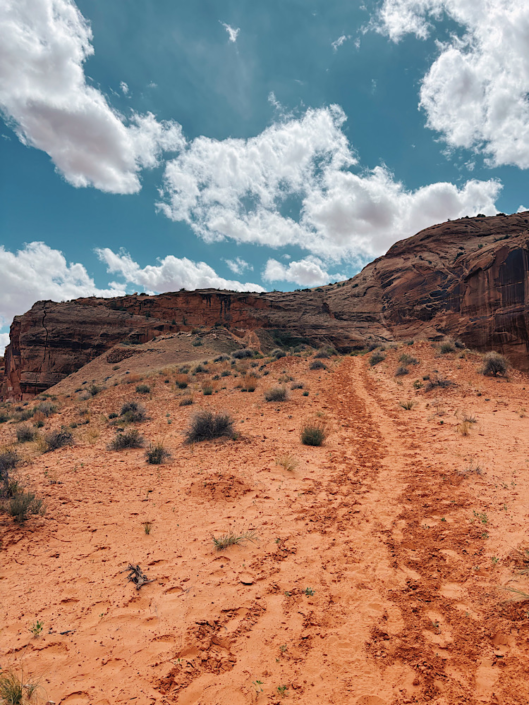
Steep sandy hill ascent (bring water!)
About Storied Rocks in Horseshoe Canyon
I am not an expert on petroglyphs or indigenous studies. I’ve simply compiled information from the National Park Service and my own experiences.
Using the term “storied rocks” is preferred over “rock art” because these panels were usually about real people and events. The Piute word for these panels, Tumpituxwinap, translates to “storied rocks.” Art has a decorative connotation. An artist interprets the world differently from an author. Think about the panels as a book.
Different Types of Storied Rocks in Horseshoe Canyon
Pictographs vs. petroglyphs: What’s the difference? Pictographs are painted onto the rock surface using colored minerals. Petroglyphs are carved or pecked. Typically, petroglyphs last longer than their painted counterparts.
Barrier Canyon Style
Barrier Canyon Style of storied rocks refers to humanoid figures typically painted with red and sometimes white minerals. They have some incredible detail if you look closely. These paintings range from 2,000 to 8,000 years old. You can find Barrier Canyon Style pictographs across Canyonlands National Park and the San Rafael Swell.
Why These Panels Are So Significant
- Well preserved
- Large-scale (life-size or larger)
- Cultural and religious significance (Holy Ghost panel)
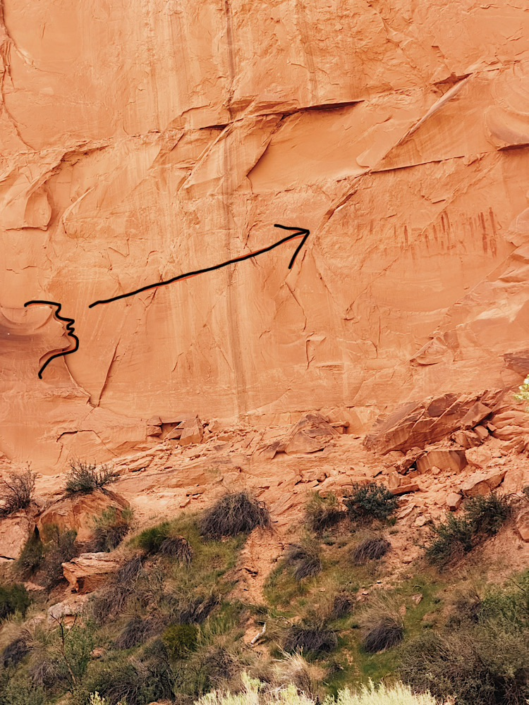
See the natural face on the rock edge?
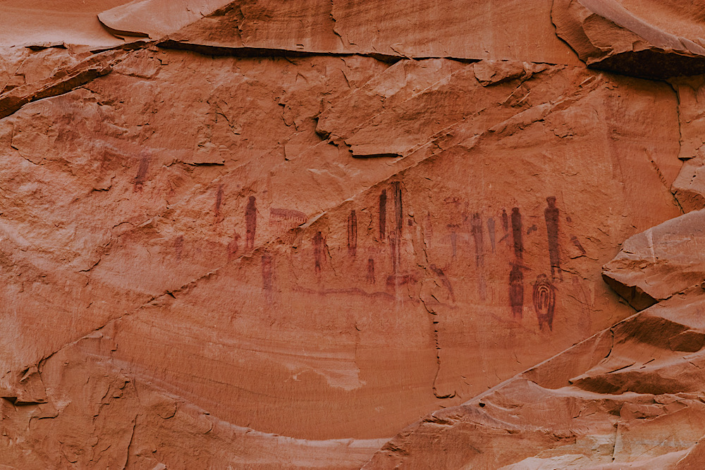
Possible interpretation of a pregnant woman at the bottom right
The High Gallery
When Ranger Jim led us to the High Gallery, we discussed the canyon erosion. Obviously, people didn’t climb up tall ladders to paint the panel. The natural ground level was much higher and has since washed away.
I asked about a particular figure that caught my eye. At the bottom-right of the panel, there is a figure with a rainbow- or horseshoe-shaped mark on its belly. Ranger Jim speculated that it might represent a pregnant woman.
I also inquired about the panel’s location. Why did people choose to paint it on this particular wall? Ranger Jim had another interesting answer. Off to the left, you can see a face jutting out from the rock edge. This feature is completely natural and not carved by humans.
Ranger Jim has a theory that the indigenous people chose this spot because they saw the face and thought it would watch over the pictographs they painted. The gaze of the face points perfectly to the panel, so it makes sense to me.
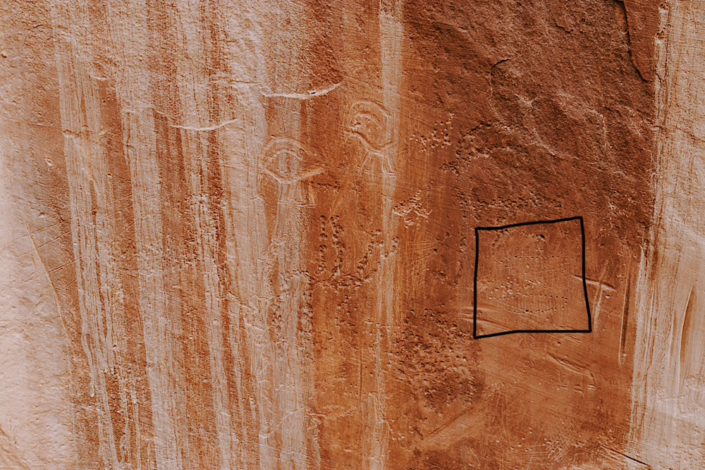
Can you make out the loom shape in the black box?
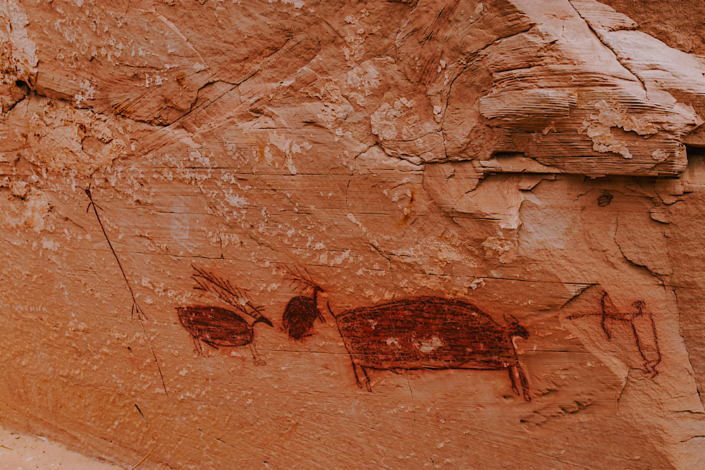
More recent pictograph possibly from a person from the plains
The Horseshoe Shelter
On the other side of the canyon from the High Gallery is the Horseshoe Shelter. This was actually my favorite storied rock location.
Ranger Jim led us to the right of the main panel, along a path most people would probably miss. I know we likely wouldn’t have noticed it on our own. Just a short scramble up the rocks revealed more pictographs.
Two sections stood out to me. One with a hunter with a bow and arrow, shooting at elk and a buffalo. Ranger Jim thought that whoever drew this section was possibly from the plains originally. (No other panels in Horseshoe Canyon depict bows and arrows with buffalo.) The figures drawn on the rock look like they were made using a crayon rather than painted.
A bit further along the trail, we came across petroglyphs pecked into the rock. These are speculated to be much older. The most intriguing of the carvings was the image of a weaving loom. I had never seen anything like it before. The detail was incredible.
Back at the main panel, Ranger Jim pointed out to us the many dogs depicted with humans. You can see the curved tails and tall ears. He thought that these dogs must have been a central part of these people’s lives to be recorded on the rock right alongside the humans.
Some of the paintings looked so sharp and saturated that they seemed to have been painted yesterday. The preservation in Horseshoe Canyon is insane.
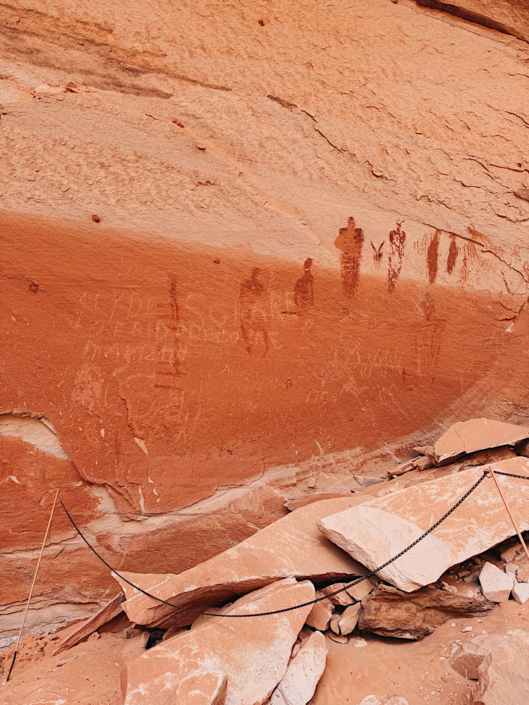
Graffiti at the Alcove
The Alcove
Unfortunately, the Alcove Gallery has suffered serious graffiti. People carving their names all over the pictograph panel deeply upsets me. You wouldn’t go into a museum or place of religious significance and write your name all over the walls. These panels aren’t any different and should be treated as such.
Before we separated from Ranger Jim at the Horseshoe Shelter, he mentioned the acoustics at the Alcove. He said you could get many echoes from a single sound. A little “yip” could be heard for several seconds.
Actually, each pictograph site has excellent acoustics. Another reason why those locations were chosen? Possibly. It’s fascinating to imagine people deciding the locations for these culturally significant, storied rock sites in Horseshoe Canyon.
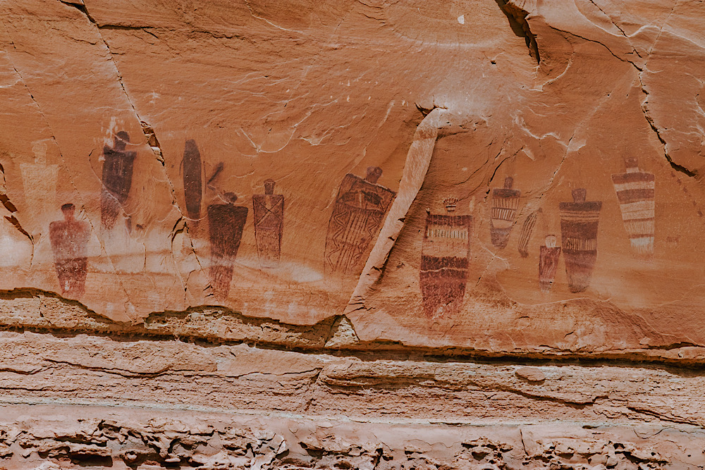
Stunning large, detailed figures at the Great Gallery
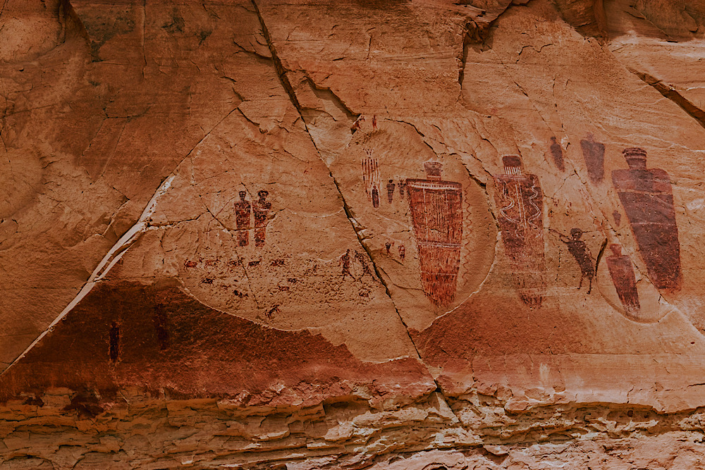
The Great Gallery
At last, we reached the Great Gallery, which is the most well-known panel in Horseshoe Canyon. It’s huge, a collection of over 80 figures. You’ll find a metal ammo box with a pair of binoculars for your enjoyment.
The binoculars help you notice details on the larger figures. Patterns and etchings that you can’t appreciate at a distance with the naked eye. Take your time to soak it all in — it’s a lot to look at.
Off to the far left, Ranger Jim told us to note the long line of tally marks. Markings like these may have tracked lunar cycles. It’s amazing all the smaller details you can speculate about in a panel of this size. Even after staring at the panel for several minutes, I kept noticing new things.
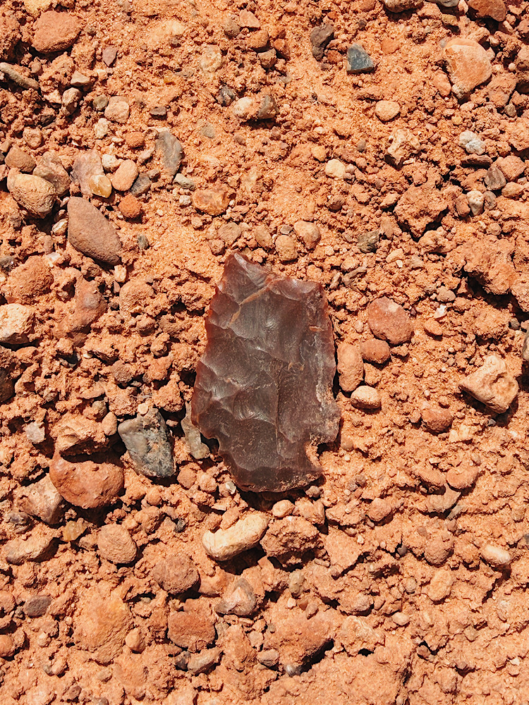
An almost whole arrowhead
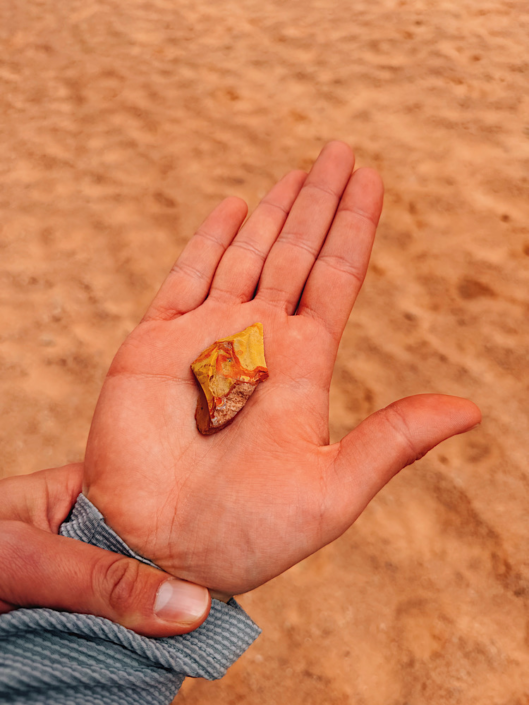
Gorgeous colored worked rock
A Note on Artifacts and Leave No Trace
As you’re appreciating these storied rock panels, please don’t touch them or carve anything into the rock surface. Let’s preserve them for people, maybe another thousand years from now, to admire.
We came across many pieces of worked flint while hiking in Horseshoe Canyon. As tempting as it was to put them in my pocket, I left them for other people to find and took pictures instead. Photos of any artifacts you stumble upon still let you show off your findings later.
Let a park ranger know if you find anything significant. Take a photo and report the location. Let’s preserve human history!
Hiking with a Ranger
I mention Ranger Jim and his perspective several times in recounting this adventure. It was completely by chance that we ended up hiking with him and spending a couple of hours learning about Horseshoe Canyon and the storied rock panels.
Experiencing the Horseshoe Canyon pictographs with a ranger completely changed how I viewed the hike. If you can, intentionally seek out a park ranger to chat with. They are full of knowledge, and I felt that I came away with a much deeper understanding of the pictographs. The park ranger will help you slow down and see beyond the obvious markings.
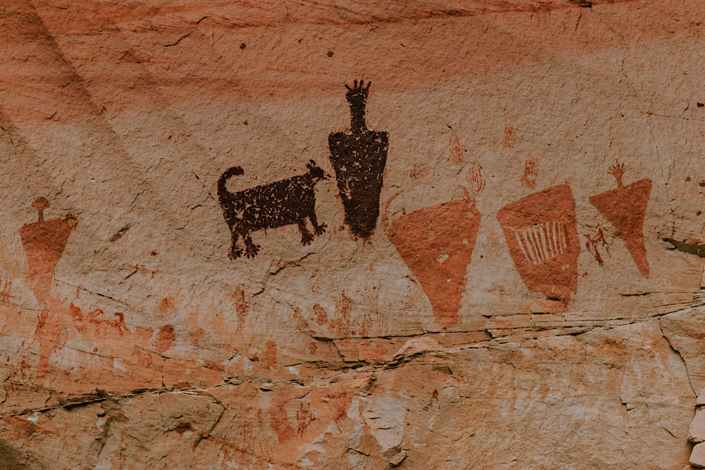
Horseshoe Shelter person and dog
Things to Know Before You Go
- Start early
- No shade
- Hiking in sand
- Plan lots of time beyond hiking pace
Hiking Horseshoe Canyon shouldn’t be rushed. You’ll want plenty of time just to sit and look at the pictographs. We reveled in our time at the panels and discussing their potential meanings. Beyond the panels, the canyon itself is stunning.
Horseshoe Canyon is a remote part of Canyonlands National Park. You won’t find your typical national park amenities. Bring all your water on your drive in and ensure you have extra water in your vehicle for the end of the hike.
Best Time to Hike Horseshoe Canyon
Hiking Horseshoe Canyon in spring or fall is ideal. It’s not too hot, but you still have plenty of daylight to work with. Start your hike early; don’t wait until noon to begin. Hiking 7 miles on its own might not take long, but you want extra time at the pictograph panels.
What to Pack for Horseshoe Canyon
- Water and electrolytes
- Snacks
- Binoculars
- Sun protection
- Hiking poles
- Extra water in your vehicle
➡️ See my day hike packing list to be prepared for almost any hike.
If you happen to have a pair of binoculars, bring them! There is a pair at the Great Gallery, but using Ranger Jim’s binoculars at the High Gallery was especially helpful.
Is Horseshoe Canyon Worth the Effort?
Hiking Horseshoe Canyon is absolutely worth the effort. Take your time and camp nearby. This trail is best for people who want a gorgeous hike with memorable history. You won’t find crowds of people down in the canyon either.
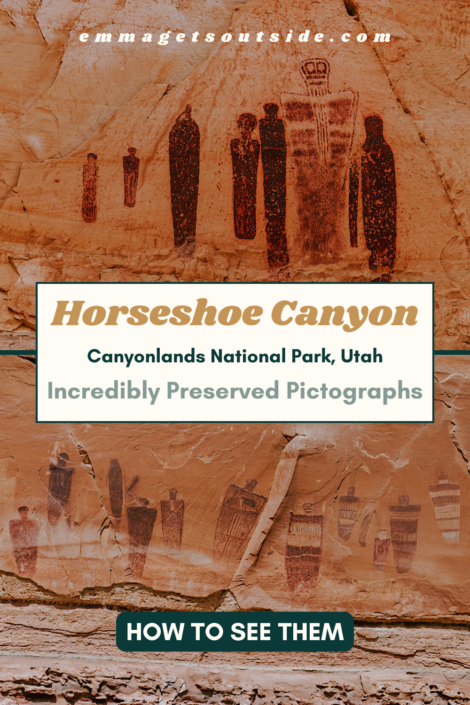
📌 Pin this image on Pinterest to save this post for reference.
FAQs About Hiking Horseshoe Canyon
Can you get to Horseshoe Canyon in a regular car?
Usually, yes, in dry conditions. The roads are dirt but generally well-maintained. However, conditions can change quickly after storms, so always check current road conditions before driving out.
How difficult is the Horseshoe Canyon hike?
I’d rate the hike as moderate. The hiking itself is straightforward, but the sandy terrain and steep climb back to the trailhead can feel challenging, especially in hot weather.
How long does it take to hike Horseshoe Canyon?
Most people should plan for 4 to 6 hours total. The hike is not one you’ll want to rush because there are multiple storied rock panels worth stopping to appreciate.
What is the Great Gallery?
The Great Gallery is the most famous storied rock panel in Horseshoe Canyon. It contains more than 80 Barrier Canyon Style figures and is considered one of the most significant pictograph sites in North America.
How long is the Horseshoe Canyon hike?
The Horseshoe Canyon hike is about 7.3 miles round trip with roughly 1,400 feet of elevation gain. Most of the elevation comes from the steep descent and climb back out of the canyon.
Is Horseshoe Canyon worth visiting?
Absolutely. Horseshoe Canyon features some of the most impressive and well-preserved storied rock panels in Utah, including the famous Great Gallery. The canyon also feels far less crowded than other parts of Canyonlands National Park.